Dr Desmond Ooi, a vascular surgeon, treats carotid artery disease, a narrowing of the two main arteries in the neck.
A narrowed carotid artery often causes no symptoms, yet it can lead to a stroke.
What carotid artery disease is
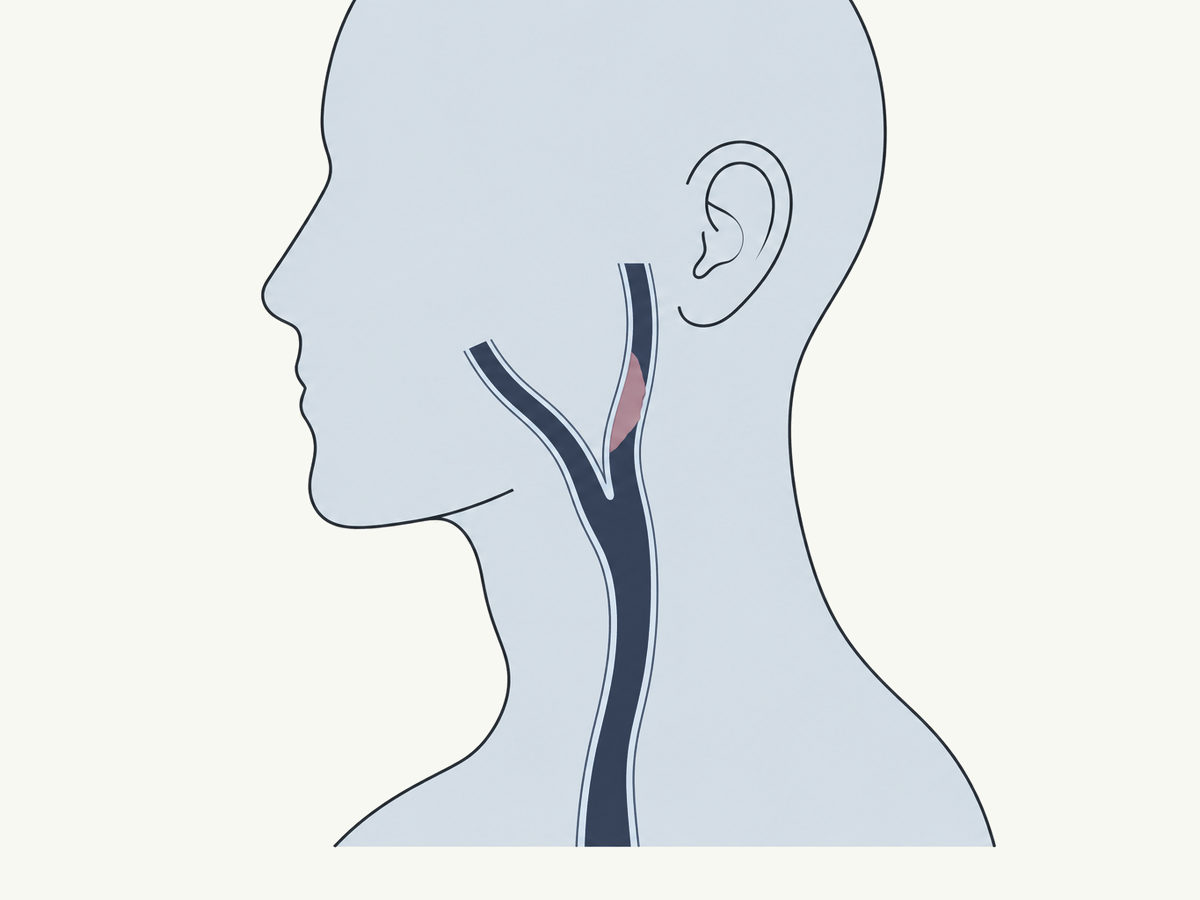
The carotid arteries are two large arteries, one on each side of the neck.
They carry blood to the eyes and the front of the brain.
In carotid artery disease, deposits of fat and calcium, called plaque, build up inside the artery wall.
The narrowing this causes is called carotid artery stenosis, or carotid stenosis.
Most narrowings form where the artery divides in two, in the upper neck. A narrowing is graded by how much of the artery's width it closes off, as a percentage.
How a narrowed carotid artery can lead to a stroke
Small clots and pieces of plaque can break off the narrowing.
They are carried up into the eye or the brain, where they block a small artery.
A short block causes a mini-stroke, also called a transient ischaemic attack (TIA).
Its signs are the same as a stroke's, but they pass within minutes, and always within 24 hours.
About 15 in every 100 strokes caused by a blocked blood supply come from a narrowed or blocked carotid artery.
After a mini-stroke, the risk of a stroke is highest in the next 7 to 14 days.
Symptoms of a blocked carotid artery, and when to call 995
A narrowed carotid artery often causes no symptoms.
For some people, the first sign is a mini-stroke or a stroke.
The symptoms of carotid artery blockage come on suddenly:
- Face, arm or leg: weakness or numbness, or a face that droops
- Speech: slurred words, or trouble finding or understanding words
- Sight: blurred or lost vision, sometimes in one eye only, or double vision
- Swallowing: trouble swallowing food or drink
- Balance: sudden unsteadiness, or a feeling that the room is spinning
If the face droops, an arm or leg turns weak, or speech becomes slurred, call 995 or go to the nearest A&E now.
If the signs have already passed, see a doctor the same day, because a mini-stroke can come before a stroke.
Who is more likely to have a narrowed carotid artery
Three things make a narrowing more likely:
- Smoking: it makes a severe narrowing more likely, and helps plaque grow.
- High blood pressure: it makes a narrowing more likely, and treating it slows a narrowing's growth.
- Diabetes: people with diabetes are more likely to have a narrowing.
Carotid artery screening of everyone is not advised.
For people with two or more risk factors for artery disease, a scan may be considered, mainly to get their medicines and risk factors right.
How carotid artery disease is found
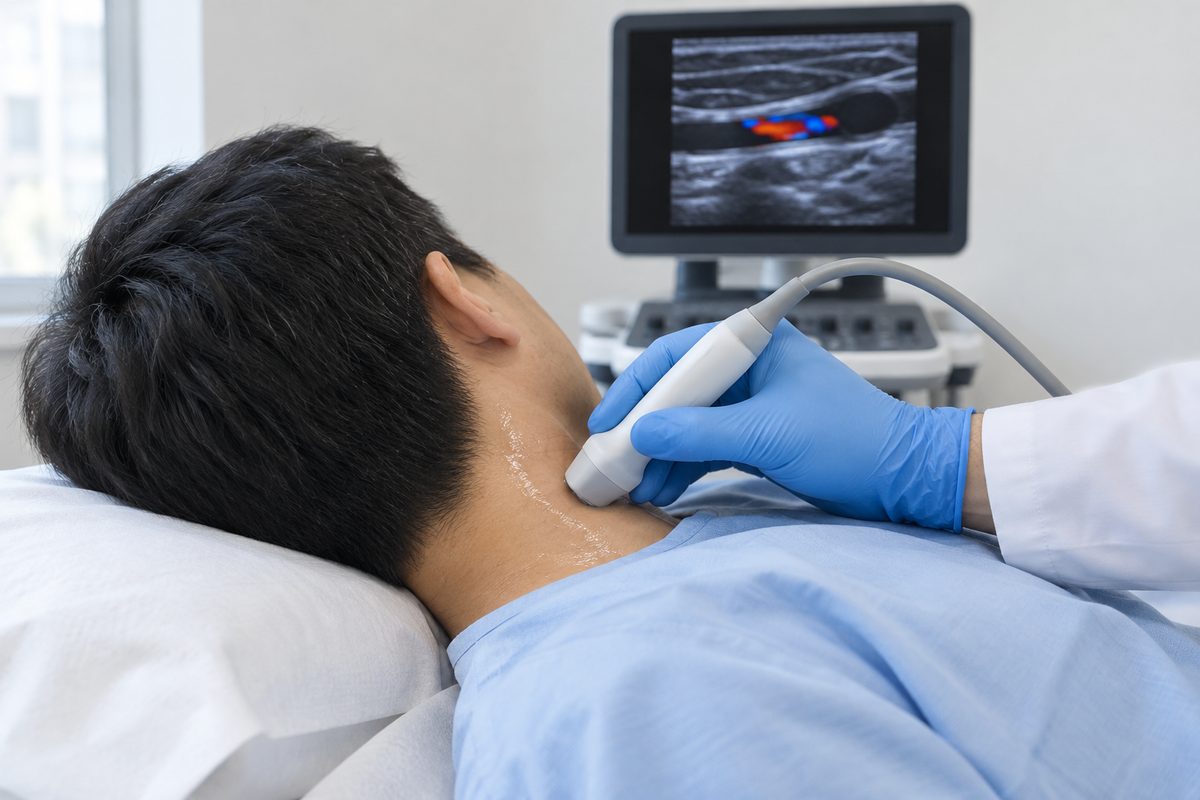
A duplex ultrasound scan of the neck shows the narrowing and measures how tight it is.
It uses sound waves, so there is no needle and no X-ray.
A CT or MRI scan of the arteries may follow, before any treatment is planned.
For people without symptoms, the scans also look for signs of a higher stroke risk:
- a narrowing that has become tighter since the last scan
- a large or soft plaque
- signs on a brain scan of an earlier, silent stroke
How carotid artery stenosis is treated
Everyone with a narrowing is advised to change their lifestyle and to take medicines, whether or not they have symptoms.
- Stopping smoking, eating well and moving more: these lower the risk of a mini-stroke or stroke.
- Antiplatelet tablets: these thin the blood and make clots on the plaque less likely.
- Statins: these lower cholesterol and help prevent stroke and heart attack over the long term.
- Blood pressure treatment: for anyone whose blood pressure is high.
Some people also need an operation or a stent:
Carotid endarterectomy
The operation is done under a local or a general anaesthetic, through a cut on the side of the neck.
The artery is opened, the plaque is removed, and a patch usually closes the artery, making it a little wider.
Carotid stenting
Usually under a local anaesthetic, a thin wire and tube are passed into an artery in the groin, the arm or low in the neck, then up to the narrowing.
A stent, a fine mesh tube, is opened inside the artery to hold it open.
Who may need carotid endarterectomy or stenting
The choice depends on whether the narrowing has caused symptoms, and how tight it is.
- After a mini-stroke or stroke: a narrowing of 70% or more is usually treated with an operation, and one of 50% to 69% may be.
- How soon: as soon as possible, ideally within 14 days of the symptoms.
- Which one: in those first 14 days, and for people aged 70 or over, the guideline prefers endarterectomy; for younger people, stenting may be an alternative.
- With no symptoms: most people are advised medicines and lifestyle changes alone.
- With no symptoms, but signs of a higher stroke risk: an operation or a stent may be considered for a narrowing of 60% or more.
The newest large trial, published in 2026, studied people with a narrowing of 70% or more and no recent symptoms.
Adding a stent to intensive medicines lowered the four-year risk of a stroke on the side of the narrowing, or of a stroke or death around the time of the procedure, from 6.0% to 2.8% (1,245 people).
Adding an operation did not make a significant difference (1,240 people).
A 2026 analysis argues that the operation may also show a benefit with longer follow-up, so advice for people without symptoms may change.

Which of these suits you depends on your symptoms, the scans, your general health and your own choice.
Questions about carotid artery disease
What are the first signs of a blocked carotid artery?
Often there are none.
The first sign may be a mini-stroke, with the signs above passing within minutes.
Even when the signs pass, see a doctor the same day.
How serious is carotid artery stenosis?
It can lead to a stroke, so it is always taken seriously.
How serious it is for you depends on whether it has caused symptoms, and how tight it is.
How to clear blocked carotid arteries without surgery?
Without an operation, treatment means medicines and lifestyle changes, which lower the risk of a stroke.
Carotid stenting is a less invasive option, done through a thin tube passed into an artery.
Can I live a long life with a blocked carotid artery?
A narrowing does not mean a stroke will happen.
The European guideline says about 8 in 10 people with a severe narrowing and no symptoms will not have a stroke over 10 years, if they follow lifestyle advice and take their medicines.
What does carotid artery pain feel like?
The warning signs the European guideline lists for a narrowed carotid artery are sudden problems with sight, speech, swallowing, strength, feeling and balance.
Neck pain is not one of them.
If any of those signs come on, with or without neck pain, call 995 or go to the nearest A&E now.