Dr Desmond Ooi, a vascular surgeon, treats thoracic aortic aneurysm, a condition that often causes no symptoms until a scan finds it.
The aorta is the main artery from the heart. It rises from the heart, arches over, and runs down through the chest and the abdomen.
In a thoracic aortic aneurysm, a section of the aorta's wall in the chest has weakened and bulges outwards.
Once a scan has found it, it can be measured, watched and, if it grows large, repaired.
Where in the chest a thoracic aortic aneurysm forms
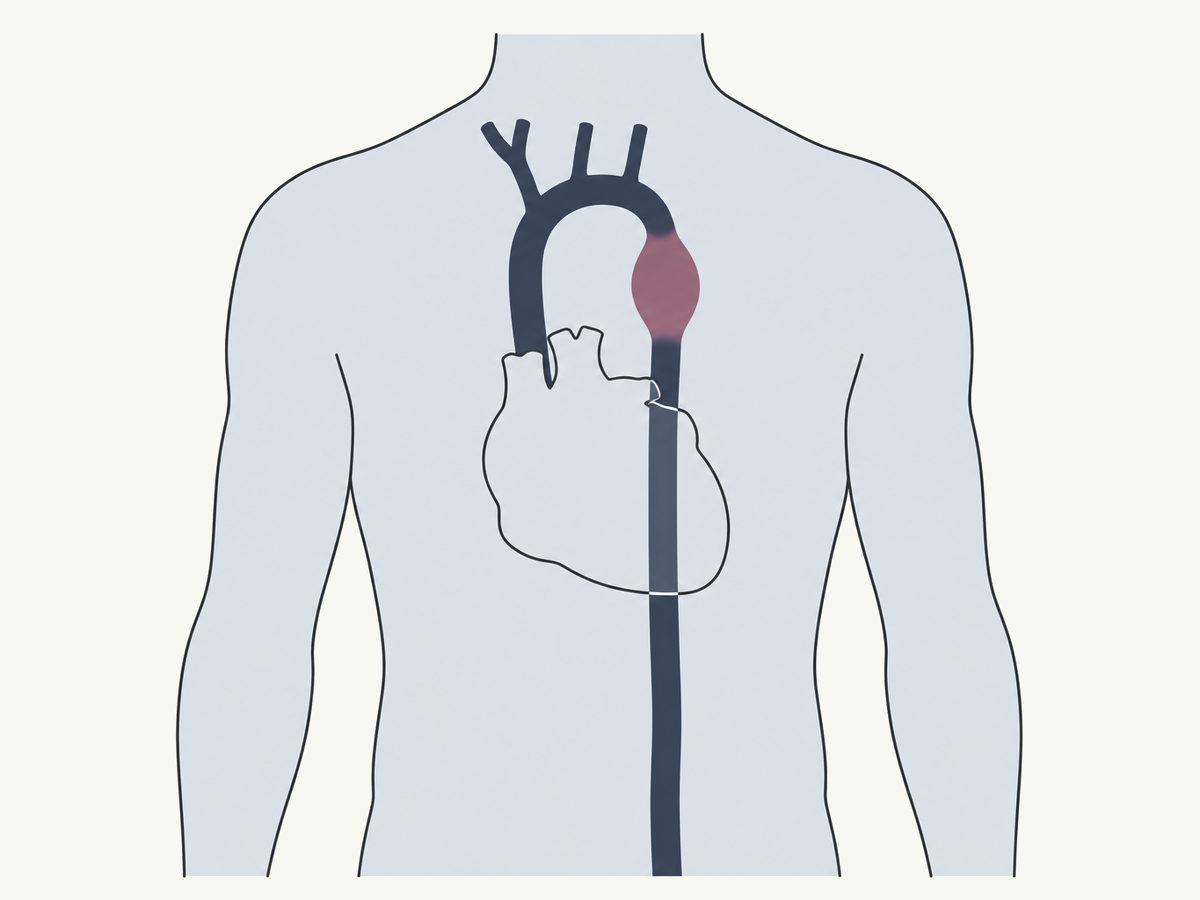
The aorta in the chest has three parts, and an aneurysm can form in any of them.
- The root and the rising part: the first section, as it leaves the heart.
- The arch: the curve at the top of the chest, where the arteries to the head and arms branch off.
- The descending part: the straight section that runs down through the chest, behind the heart, towards the abdomen.
The part where the aneurysm sits decides how it is watched and how it is repaired.
On a scan report, a widened aorta in the chest may be called a dilated aorta.
An aneurysm lower down, in the abdomen, is an abdominal aortic aneurysm.
Thoracic aortic aneurysm symptoms, when there are any
Most thoracic aortic aneurysms cause no symptoms for years.
Many are found by chance, on a chest X-ray, a CT scan or a heart scan done for another reason.
As one grows, it may press on what lies near it and cause:
- A deep ache in the chest or the upper back
- A hoarse voice
- A cough or shortness of breath
- Trouble swallowing
These signs have many other causes, and a doctor's check tells them apart.
The signs of aortic rupture
Aortic rupture is a burst in the wall of the aorta, and it causes heavy bleeding inside the body.
There may be no thoracic aortic aneurysm symptoms before rupture, or the first sign may be new pain in the chest or back.
A large aneurysm can also tear inside its wall, which is an aortic dissection.
If you have sudden, severe pain in your chest or back, often described as tearing, call 995 or go to the nearest A&E now.
What causes an aneurysm in the chest, and why it can run in families
The wall of the aorta can weaken with age, with conditions that strain it, or because of a condition a person is born with.
- High blood pressure
- Smoking
- Hardening of the arteries, called atherosclerosis
- A heart valve with two flaps instead of three, called a bicuspid aortic valve
- An inherited condition of the body's connective tissue, such as Marfan syndrome
- A parent, brother or sister with an aortic aneurysm or dissection
Some aneurysms in the chest run in families, even when no inherited condition has been named.
If a close relative has had one, ask your doctor whether you should have a scan.
How the aneurysm is measured, and how fast it grows
A scan measures the width of the aorta and shows which part is widened.
- CT scan: detailed pictures of the whole aorta, also used to plan a repair.
- Echocardiogram: an ultrasound scan of the heart, which shows the first part of the aorta.
- MRI scan: detailed pictures taken without X-rays.
Repeat scans, months or years apart, show whether it is growing.
In a 2025 review of the published studies, aneurysms in the rising part of the aorta, near the heart, usually grew by a quarter of a millimetre to one millimetre a year.
Aneurysms in the descending part grew faster on average.
How a dilated aorta or an aneurysm in the chest is treated
Dilated aorta treatment depends on the size of the widening, how fast it grows, where it sits and your overall health.
Regular scans and blood pressure control
A smaller aneurysm is usually watched with regular scans.
Keeping your blood pressure under control and stopping smoking help protect the wall of the aorta.
Repair by open surgery
In open surgery, the weakened section is replaced with a tube of fabric, called a graft.
Aneurysms of the root and the rising part, next to the heart, are usually repaired this way, by heart surgeons.
Repair with a stent graft from inside
In endovascular repair, a stent graft is passed up through an artery from the groin and opened inside the aorta, to line the weakened section from inside.
In the descending part of the chest, the repair may be open surgery or a stent graft, and the European vascular surgeons' guideline of 2026 covers this part of the aorta.
Questions patients ask about thoracic aortic aneurysm
Can you survive a thoracic aortic aneurysm?
Yes, many people live with a small one for years, watched with regular scans.
The danger is a large one that tears or bursts, which is why its size is checked and a large one is considered for repair.
Is thoracic aortic aneurysm serious?
It can be. A small one may never need repair, while a large one can tear or burst, which is life-threatening.
Regular scans show how large it is and whether it is growing.
How serious is a dilated thoracic aorta?
A mildly widened aorta in the chest often grows slowly.
Its width on repeat scans, and which part of the aorta is widened, decide whether anything more than scans is needed.
What to avoid if you have a thoracic aortic aneurysm?
Avoid smoking, and do not leave high blood pressure untreated.
If a doctor prescribes you an antibiotic, say that you have an aneurysm: a 2021 review linked one group of antibiotics, the fluoroquinolones, with aortic aneurysm and dissection.
Ask your doctor which kinds of exercise suit you.
What is a descending thoracic aortic aneurysm?
It is an aneurysm in the descending part of the chest aorta, the straight section that runs down behind the heart towards the abdomen.
When it needs repair, it can be repaired by open surgery or with a stent graft from inside.
How do you stop an aortic aneurysm from growing?
Keeping your blood pressure under control and not smoking are the main steps you can take.
Regular scans show whether it is still growing, so that a repair can be considered in time.
Are aortic aneurysms hereditary?
Some are. Aneurysms in the chest can run in families, with or without a known inherited condition such as Marfan syndrome.
If a parent, brother or sister has had an aortic aneurysm or dissection, ask your doctor whether you should have a scan.